Showing posts with label DRM. Show all posts

Sunday, 16 November 2008

Piracy Makes Games Suck

I'm a geek. I'm not shy about that fact. Being a geek means you have friends who are geeks. Having friends who are geeks means that when a new game or movie comes out, you're sometimes offered a copy before it's even been released. Piracy is big, especially in the PC gaming world. Less so for console games, but don't think it doesn't happen.

Games are expensive. It's a fact. If you take into account the level of quality people want in their games these days, and what it costs to make them, it's not surprising the unit price is so high. And don't tell me movies are cheap games should be. In movies they only have to worry about how it looks, not what'll happen if the player decides to do something ridiculous. 

So when you're offered an opportunity to play the game, no strings attached, before you pay for it (if ever), people tend to go for it. But what are you missing?

Many times the process of cracking the game breaks some aspect of the game. Things like online play or achievements. In some cases the game may crash because of the workarounds involved. Some people may seize the opportunity to plant and distribute their virusses through these "cracked copies". Often, in an attempt to crack the game before the official release date, an unfinished or reviewer's copy of the game is used, which may include critical errors. Cracked games can also not be patched, leaving it open to vulnerabilities or flawed gameplay. For the online play that did work with the cracked version, the fact that you can't patch it means that now you can't play online because the servers require you to have the latest fixes installed.

And worst of all, your experience of the game is tainted. 

As a programmer I know how it goes. You sit for days writing a small part of the game or program, but you can't get it perfect. You've been working so hard on the whole project that you think this little problem can be fixed later, or is really not so bad. So someone gets a pirated copy of your game. They didn't pay for it so they're willing to install it and try it for an hour or two. If they don't like it, they skip it. Or worse yet, they go onto public forums and discredit your game because of that small niggle in gameplay you decided can be left. They are in general more critical of the game.

If they had payed for the game, they would see the niggle, but think to themselves "It's really not that bad. The rest of the game makes up for it. It's a good experience in general." Because they payed for it, they want to get their money's worth so they give the game a proper chance.

Personally, I enjoy a game more if I have the physical package I can put on my shelf. Often the game comes with some special trinket, or there's a collector's edition. It makes it an experience instead of a pastime while you wait for your pizza to be delivered or whatever.

The last problem I have with piracy is DRM. I know it sounds backwards, but it's simple. When games are pirated, the producers don't get money for it. So they need to stop a game from being pirated. They end up licensing outside software to do it for them (Starforce or SecuROM). These methods are never perfect because no two computers are set up the same, so by doing so you introduce a margin of failure to your games: a number of buyers for whom the game will not work because something on their computer isn't how it should be. In some cases it also introduces an install limit. Someday I'm going to look at an old game and think "I want to try this again", but when I try to install it, the game will firstly require internet access to a service that may no longer be available. If that service is still there, it may tell me that I've installed the game too many times. How can this be? I'm sitting with the disc in my hands. I payed for it. The slip is still in the case, although the writing has faded a bit... If I pay these exorbitant amounts for my game, I expect it to work when I want it to.

Even games with DRM gets cracked. Sometimes the DRM is only there to stop it from being cracked on release day, but it will be cracked within a week. However, it ruins the game for years to come.

Unfortunately piracy is here to stay. Unless they can find a way to make sure you can't do anything without a legal copy (WoW did it) you can really only rely on people's good faith and support.


Words:
"In the case of pirates, say, I would like to know whether that profession of theirs has any peculiar glory about it. It sometimes ends in uncommon elevation, indeed; but only at the gallows."
-Herman Melville

Tuesday, 24 June 2008

Too Safe To Care

The main reason game development companies prefer creating console games over PC, is because PC games are so easily pirated. For years companies have tried everything to keep their games safe and their players legal, from CD keys to encrypted discs to draconian rootkits.

In a few cases, these copy protection devices were so strict that legal buyers of the game were unable to play it. I myself was once unable to play a game after it detected I run a virtual DVD drive. The drive, mind you, I use when installing linux-based software to my VirtualBox, software that is usually distributed as an ISO for download.

The most memorable occurrence of this was BioShock. It was announced that the game would require players to activate their game online, and would only be allowed to install the game 5 times. Ever.

You can imagine how this upset many people. There was a public outcry on the gaming forums and the company eventually removed the activation limit last week.

The next big scandal was Assassin's Creed for PC. Some users noted funny internet traffic while playing the game, which has no multiplayer. It turns out that the game was "phoning home" every 3 minutes to make sure your copy was still legal. I have a wireless internet connection that isn't the most stable of ways to get online. On several occasions the game would completely lock up, as if waiting for something to happen, before continueing. I noticed that this didn't happen if my internet was disconnected. Proving the point that the game was indeed waiting for confirmation before continueing. This was not documented anywhere and users' permission was never asked, although upon finer reading of the license agreement it was found that by clicking "I Agree" you give them permission to collect " anonymous user data". Surprisingly this created little media stir.

But when it was announced that Mass Effect for PC would use a similar scheme (but only every 10 days or so) the general public exploded in rebellion, many urging players to pirate the game BECAUSE of the protection, thereby defeating the purpose and proving a somewhat elaborate point, which I'm getting to.

The "phone home" was removed, but in such a haste that for many people (your's truly included) the game can't even run. I'm hoping this will get fixed in the not-too-distant future, as I can't return the game.

I found out today that Alone in the Dark uses the same system. When the game is installed it must activate, either over the internet or through lengthy phone conversations with technical support. When you uninstall the game, it must revoke its activation in much the same way. This means if your computer accidentally fails under the pressure of its daily workings, there is no way to legitimately uninstall the game and it will not allow you to install again until you have revoked the activation, which means more lengthy phone conversations to explain why you want to play the game on another computer (or again on the same computer).

If I may be frank, this is bullshit. If I pay for the game, I want to play the game. Why should I need to explain myself to some third party? "Yes I legally bought the game. No it is not installed on another computer. Yes I can give you my product key."

I understand that they don't want the game to be copied, but they're trying to hard to stop people from copying it, that they convince people to pirate the game simply to avoid the shlep of activating it! You're losing precious sales here, people!

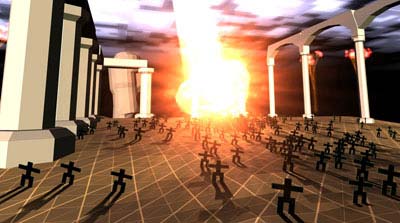
Look at Darwinia. The game has no copy protection whatsoever (as far as I can tell). It is indeed pirated and easily available on the internet, especially because it's a comparatively small download. I know a few people who illegally downloaded and played the game, but once they realized what a gem of a game it is, they went out and bought it as a sign of due diligence.

We gamers give credit where credit is due. If we think a game is worth our R315 (Alone in the Dark), we'll gladly pay it. But I might think twice about it if I know I'm going to have to explain my purchase to some woman in an office 10 000km away, if not overseas. And then the game might not even work because of my shoddy internet connection! I can see it now.

"Hey John let's play Alone in the Dark!"
"OK but I need to get my internet running..."

...followed by pointless fiddling with a foil-covered paper plate in an attempt to direct the onmidirectional signal out a window towards a tower...

Bottom line: If you try too hard to stop people from pirating your game, they're going to pirate your game just to spite you. If you let people (relatively) freely distribute your game illegally, many people will feel obligated to pay for the game and you will end up with more sales.


Words:
"But it's not. It's basically an 18 to 28 year-old male dominated business of about 15 million. That's where most of the traffic is. Casual games on the net add to that, but they're all network-based."
-CVG Article