Showing posts with label games. Show all posts

Wednesday, 11 November 2009

Vampires...


The world was recently swept with Vampire Fever. It probably started with the TV series True Blood, but it really took off through the sudden fame of the movie Twilight and subsequently the mass consumption of the books it's based on. The entertainment media has suddenly flooded with variations on the theme. New series such as Vampire Diaries (also based on books) and a Twilight board game is the first that come to mind.
But the concept of vampirism has always been present in fiction. The first would probably be Dracula, but with the sudden surge of interest all the old dogs were reawakened. Moonlight, Interview with the Vampire and Queen of the Damned, by extension Anne Rice books, the World of Darkness roleplaying system that I myself am so fond of, Vampire Knight... Suddenly vampires are no longer something to be feared, but something to be admired, adored, or even... worshipped... Why is this?

First I must state that this is written from a mostly male-vampire-to-female-human point of view. In many cases these points apply both ways, but my thinking is linear and heterosexual as I write this.

Now that it has entered the mass media, why does every other person find vampires so attractive? In many cases there's nothing special about them save for the fact that they drink blood. I think it is the element of mystery. People are afraid of what they don't understand, but they are excited and intrigued by the knowledge that there is something they don't understand. The same way you love rollercoasters even though they make you fear for your life. The risk is a rush.

Beside this stands the fact that these popularised vampires are elegant, sophisticated beings. They are the embodiment of suave. Usually they are financially secure to the point that it becomes difficult to judge their net worth. They have a strong lineage and family traditions. Their family and their loyalty towards it is of utmost importance. Essentially they appeal to everything our culture defines as a perfect partner. We find them attractive because they are, in all aspects of society, your key to a comfortable lifestyle.

But what about the fact that they can't go into the sunlight? First let me mention that for the sake of storytelling this detail is often skewed. Some can walk in sunlight for short periods but it makes them violently ill (Moonlight), others have certain artifacts that make them immune to the effects of sunlight (Vampire Diaries), others are quite comfortable under indirect sunlight, but suffer negative effects when exposed to direct sunlight (sparkling characteristic from Twilight). But the aversion to sunlight has a purpose: It shows a weakness. It is difficult to believe that a creature of such magnitude and strength can be brought down by something we find so commonplace that most of the time we barely notice it.

Not only do they attract us in their physical appearance, their strong personalities and financial or social fortunes, they also display a weakness, which our maternal and paternal instincts pick up on. We want to help the weak.

Last point I'm going to ponder on is the concept of immortality. Vampires live forever save for certain extreme conditions (fire, decapitation, sunlight etc). We find them attractive because we fear death and they provide something that can save us from this inevitable unknown.

So as a closing argument, when my friends swoon over a vampire character of some sort, I let them. There's nothing we committed companions can do to stop it. On a purely evolutionary level we are outclassed. Luckily these characters are simply that, fictional beings. All we can do is wait for the infatuation to end...


Words:
"There comes a time for every vampire when the idea of eternity becomes momentarily unbearable. Living in the shadows, feeding in the darkness with only your own company to keep, rots into a solitary, hollow existence. Immortality seems like a good idea, until you realize you're going to spend it alone."
- The Vampire Chronicles: The Vampire Lestat, Anne Rice


Wednesday, 19 August 2009

Board Games

When I say board game the first thing that popped into your head is probably Scrabble or Monopoly. Though these are both brilliant games, it's not nearly an accurate description of the phrase. Before computers, TV or even radio, board games were one of the most enjoyed indoor pastimes. Some board games have prevented all-out war between nations. Some games have remained unchanged for millennia. And still today board games are a popular pastime in the slightly-less-than-mainstream circles, global sales climbing 23.5% in 2008.

Broadly speaking you can split board games into a few categories, which I'll cover one at a time.

Abstract
These games tend to focus on strategy more than story. Almost everyone can play Chess to some degree, but it's not nearly the only game of its kind. A personal favourite of mine is Go, a Japanese game that evokes the same strategic thinking as Chess but with far simpler rules and a certain degree of elegance that few games can achieve. Another 2-player game I enjoy is Mancala, an old African/Asian game of moving marbles or stones around little pots. For its simplicity in rules there is some amazing strategic depth.

Party Games
It happens every so often that I would be hanging out with friends and a bottle or two of wine, and someone would say "Hey let's play 30 Seconds!" This is a typical party game. Easy to learn, fun to play, with little downtime between turns. Another good example is Clue (I still have a copy called Cluedo, when it was British). Party games tend to finish in under an hour, before it becomes repetitive.


Family Games
Games that are easy to learn and easy to play, and often don't require quite as much strategy. Good examples would be Boggle, Scrabble and Upwords (pictured above). Most family games also make good party games, such as Pictionary.


Eurogames
This is where I got into board games. Eurogames derive the title from the fact that the first games of this style came from Germany and became very popular very quickly. The games tend to have a basic back story to give context and theme, but what makes them most intriguing is that each game has a unique gameplay mechanic that is found in very few other games if any. The most famous eurogame is Settlers of Catan, but Carcassonne, Ticket To Ride (links to video review) and the newcomer Dominion are all worth a mention.

Fantasy Games
These games sacrifice simplistic rules for depth of story and intense scenarios. The games tend to play longer (2-6 hours) and have a very thematic style, usually fantasy but sometimes based on a TV series or game. I wouldn't recommend these games to the beginning board gamer, but if you've played Magic: The Gathering or some form of roleplaying such as D&D you'll fit right in here. Actually, the World of Warcraft game is quite popular... My friends and I have been playing Runebound (pictured above), which is an RPG in board game form. There's also a game for Battlestar Gallactica that many people are raving about.


Wargames
Warning: Only for the hardcore. These games typically take months of buying units, painting them and researching combat strategies. The rules are complex enough to emulate real-life warfare. If you enjoy RTS games you can try this, but it's not for the beginner or even intermediate player, and you'll need quite a bit of cash to get started. The most famous in this genre is Warhammer 40,000 (pictured above). There are also boardgames that give the same type of combat style without the hassle of amassing an army, though the games can still take a few hours to play. I would recommend HeroScape(very pretty) or Warriors of God.

So to conclude, I believe there's a board game out there for everyone. And once you're hooked you'll keep looking for something "the same but different", that will slowly introduce you to the wonderful world of board games. Places to go for more information would be BoardGameGeek, Board Games With Scott and The Dice Tower.

What board games do you enjoy? Comments welcome.

Sunday, 11 January 2009

Puzzles

When last did you build a jigsaw puzzle?

Can you even remember? It's something our parents did. Or not even. Maybe you remember visiting your grandmother's house and there was an uncompleted puzzle on the dining table. But why don't we see puzzles anymore?

Because kids play computer games and consoles, that's why. You even get jigsaw puzzle games! I've said many times that I am a gamer. I'm not ashamed of it. But I know you can't spend your entire life behind a monitor. Use your hands for once!

Puzzle building has some very important skills to teach, the most obvious ofwhich is pattern recognition and being able to notice a part of something even when presented seperate from the whole. It also improves hand-eye coordination, dexterity and visual memory.

Then there are secondary skills you learn, like planning:
If you're searching for a specific piece but can't find it, maybe you should try building around that piece and getting some more imformation on its shape, or leave it for the time being and try somewhere else. Sometimes you can gather all the pieces that "look like sky" to narrow down your search. That's problem-solving right there!

It also destresses because you can calmly sit and scan the pieces for the one you're looking for. And it's addictive. When you keep finding a piece every few minutes, whole afternoons can fly by. Every time you find a piece it feels like you're getting somewhere and you only need a few more.

Not to mention the amazing artwork. This picture is the puzzle we just finished. When you first look at it you think "but it's all the same colour!". It's not. The clouds in the sky are smooth, the sea is rough. The ghost ship is a very distinct white. Even the lace on her dress allows you to find similar pieces.

I bought my mom a world globe puzzle a year back. Yes, the puzzle is three-dimensional. I've also seen some interesting games made from puzzles. My aunt has a puzzle that doesn't have a picture on the box. It's a murder mystery. You read the little story of how the people came to be in the house, heard the gunshot and found the body. Then the puzzle is the crime scene and as you build you discover the killer's identity.

Jigsaw puzzles are extremely underrated as a pastime. I think everyone should have at least one puzzle in their house at all times, even if you never build it, your children or friends might. And as soon as they do you'll be hooked. Puzzles are cheap in comparison to other games, and will keep you entertained for much longer than a stupid DVD...


Words:
“There are no extra pieces in the universe. Everyone is here because he or she has a place to fill, and every piece must fit itself into the big jigsaw puzzle.”

Tuesday, 9 December 2008

Boredom

When I think back to my childhood (when I was about 13), the first thing I think of is the stupid stuff we got up to during summer holiday. Spending hours outside, walking from friend's house to friend's house, getting into trouble as often as humanly possible... Good times were had.
But why did we do this? Why did we mess around for days on end? Because we were bored. We had nothing to do.

A decade later, I have no time to do the things I want to. I realise that this is partly because I now have a job, but if I look purely at the list of things I want to get to, there's ten times more stuff on my list. When I was a kid, we entertained ourselves. We made stuff up. We pretended. These days, you don't have to imagine. If you want a fantasy story, you play a game with a fantasy story in it. If you want to pretend to race around, you go to the carts track and race.

In my day, we built soap box racers. I think I'm one of the last generations to actually do this. You didn't just get in and press the win button with your foot. You actually designed the thing, planned it out, built it, tested it. And when you ended up in a ditch you learnt from the experience and did it better next time.

Kids these days can buy their "soap box racer" at the store. It's plastic. It's made in a factory. And it comes with seatbelts and airbags, because heaven forbid you actually hit something and got hurt. And if somehow you did manage to get hurt, your parents sue the living daylights out of the manufacturor.

How sad is that? That you can't even get hurt anymore. It's an integral part of childhood!

Here's what scares me: Writers use their imagination to create worlds for their readers. Their imaginations are vivid because they played in the garden when they were a kid. They made stuff up. When the children of this generation grow up... where will their inspiration come from? Will they simply derive their stories from the stories they've read before? Will they base it on the inherintly crappy stories in games?

Are we the cause of imagination's extinction?

You don't have to imagine you're a jedi, running around with a broomstick going "woooooom! wooom!". You just play the Star Wars game. Don't get me wrong, the games are great. But at some point kids need to put down the game and actually use their brain.

Be creative. Try to solve problems. Get it wrong. Get hurt. This is how you learn. This is how you discover what it's like to lose. This is what shapes your future. Live it.


Words:
"1000 times I have accepted the drudge work and delivery jobs and assassination requests and diplomatic missions and more for every random person I've met in the game. And yet, I get resentful every time my wife asks me to take out the trash. Something is not right here. And while I'd love to ponder it more, I really do have to get back to the game now. Oh wait, no---I'm at work! Shit!"
-Jeff Green


Saturday, 29 November 2008

With Vilest Worms To Dwell

If you've played PC games, there are two games that you will know of. Even if you haven't played them yourself, you know of them. The first on is easy: The Sims. The second one I'm sure you won't guess, but you will recognise it.


My first experience of Worms was when I was 11. I got Worms Reinforcements for Christmas and my two cousins and I played staight through the night until the sun came up. 

What intrigued me about the game was its learning curve. You scale to the game, instead of the game scaling to you. I know it sounds backwards, but allow me to explain: Generally when you play a game they start you out with simple challenges so you can learn the ropes. Then they slowly step up the difficulty so that you're always challenged. In Worms, the game mechanics stay exactly the same. But as you get to know the weapons and how they work, you start making more daring moves, often risking the life of your own worm in pursuit of the enemy. Of course you can scale the abilities of your opponents, and which weapons are allowed when, but how the weapons function and how you use them never changes.

And the most important fact of the game: No matter what weapons you have or how devestating their effect, your enemy can always take you down with a bazooka and a grenade. Because these weapons require time to master. To throw a grenade halfway across the map into a hole no wider than the grenade itself is a feat very few can achieve. And bazooka rounds are affected by the wind, allowing you to shoot around corners! 

What's best of all, is that the game is turn-based. You only need a single computer, a single set of controls, and a single copy of the game to enjoy it with friends. This post came about when we had the idea of playing on the projector. 3 meter wide total wormage!  

The version we're playing is Worms Armageddon (cover pictured below), and is my personal favourite of the series. Even though the game came out in 2001, it runs perfectly on Windows XP and Windows Vista. And the ability to set any resolution means you can play in HD. Later versions of the game became 3D, making it more modern in concept but harder to aim and shoot as effectively as the original 2D game. It also means having to use the mouse and keyboard much more. When we play on the projector, I map the keys to my Rumblepad so we can pass it around easier.


I would urge anyone to try this game, or its many derivative works, for themselves. Links listed on the wikipedia page. And don't worry about violence. It's cartoony graphics. I've seen Road Runner cartoons with more violence.


Words:
"So if reality gets in the way of fun, fun wins."
-Gamers With Jobs Conference Call, Episode 111


Sunday, 16 November 2008

Piracy Makes Games Suck

I'm a geek. I'm not shy about that fact. Being a geek means you have friends who are geeks. Having friends who are geeks means that when a new game or movie comes out, you're sometimes offered a copy before it's even been released. Piracy is big, especially in the PC gaming world. Less so for console games, but don't think it doesn't happen.

Games are expensive. It's a fact. If you take into account the level of quality people want in their games these days, and what it costs to make them, it's not surprising the unit price is so high. And don't tell me movies are cheap games should be. In movies they only have to worry about how it looks, not what'll happen if the player decides to do something ridiculous. 

So when you're offered an opportunity to play the game, no strings attached, before you pay for it (if ever), people tend to go for it. But what are you missing?

Many times the process of cracking the game breaks some aspect of the game. Things like online play or achievements. In some cases the game may crash because of the workarounds involved. Some people may seize the opportunity to plant and distribute their virusses through these "cracked copies". Often, in an attempt to crack the game before the official release date, an unfinished or reviewer's copy of the game is used, which may include critical errors. Cracked games can also not be patched, leaving it open to vulnerabilities or flawed gameplay. For the online play that did work with the cracked version, the fact that you can't patch it means that now you can't play online because the servers require you to have the latest fixes installed.

And worst of all, your experience of the game is tainted. 

As a programmer I know how it goes. You sit for days writing a small part of the game or program, but you can't get it perfect. You've been working so hard on the whole project that you think this little problem can be fixed later, or is really not so bad. So someone gets a pirated copy of your game. They didn't pay for it so they're willing to install it and try it for an hour or two. If they don't like it, they skip it. Or worse yet, they go onto public forums and discredit your game because of that small niggle in gameplay you decided can be left. They are in general more critical of the game.

If they had payed for the game, they would see the niggle, but think to themselves "It's really not that bad. The rest of the game makes up for it. It's a good experience in general." Because they payed for it, they want to get their money's worth so they give the game a proper chance.

Personally, I enjoy a game more if I have the physical package I can put on my shelf. Often the game comes with some special trinket, or there's a collector's edition. It makes it an experience instead of a pastime while you wait for your pizza to be delivered or whatever.

The last problem I have with piracy is DRM. I know it sounds backwards, but it's simple. When games are pirated, the producers don't get money for it. So they need to stop a game from being pirated. They end up licensing outside software to do it for them (Starforce or SecuROM). These methods are never perfect because no two computers are set up the same, so by doing so you introduce a margin of failure to your games: a number of buyers for whom the game will not work because something on their computer isn't how it should be. In some cases it also introduces an install limit. Someday I'm going to look at an old game and think "I want to try this again", but when I try to install it, the game will firstly require internet access to a service that may no longer be available. If that service is still there, it may tell me that I've installed the game too many times. How can this be? I'm sitting with the disc in my hands. I payed for it. The slip is still in the case, although the writing has faded a bit... If I pay these exorbitant amounts for my game, I expect it to work when I want it to.

Even games with DRM gets cracked. Sometimes the DRM is only there to stop it from being cracked on release day, but it will be cracked within a week. However, it ruins the game for years to come.

Unfortunately piracy is here to stay. Unless they can find a way to make sure you can't do anything without a legal copy (WoW did it) you can really only rely on people's good faith and support.


Words:
"In the case of pirates, say, I would like to know whether that profession of theirs has any peculiar glory about it. It sometimes ends in uncommon elevation, indeed; but only at the gallows."
-Herman Melville

Monday, 27 October 2008

Casual To The Core

Casual games have taken over. I think it makes sense. People seldomly sit down behind a computer and say to themselves: "Right, now for a few hours of gaming." Only people that really enjoy games would do that. A casual game allows you to sit down for a quick game. Sometimes you end up spending hours there anyway, but the thought of dedicated a section of your day almost to the activity of inactivity is a daunting concept. 
That's World of Goo. I've been playing on and off for a few weeks now and it's always engaging. Casual games can be described in 3 words: Simple, repetitive, challenging. These elements, when present in the right quantities, will deprive you of hours of your day. And the hours that you don't spend playing, you spend thinking about the challenge you stopped on and how to defeat it.

But as much as I enjoy simple, addictive games something happens to me after a while. If I spend too much time playing these simplistic games, I begin to crave the depth, detail and immersion offered by larger titles. I want that imaginary world with its folklore and cultures. I want to feel like I'm in control of someone's destiny, that my choices have purpose other than the completion of an arbitrary task. I want to play something that will suck me in and keep me interested like a good novel on a sunday afternoon. As much as the gamer world thinks casual games are taking over, there will always be a market for the core gamers. There will always be lonely teens that need something to keep them busy over a weekend.

Just look at console games. A console used to be simple, addictive games with the occasional racing title thrown in. These days all the big genre games are coming out on console, catering for the "pop it in and play" crowd.

Like they say, the devil is in the detail...


Words:
"Not even halfway, but in the beginning it's like 'Oh there's Rosco Street Station! Oh there's those jittery bums, you know on the bench. There's the valkeer stuff painted on the... exactly like it is in the game.' You're like 'Alright the got the tone down! We're set to go!' And so it happens. He like shoots the doors open and then... you know... raises his voice..."
- In-Game Chat 27 October 2008, comparison of Max Payne movie with original games.


Sunday, 5 October 2008

Like Chess But Different


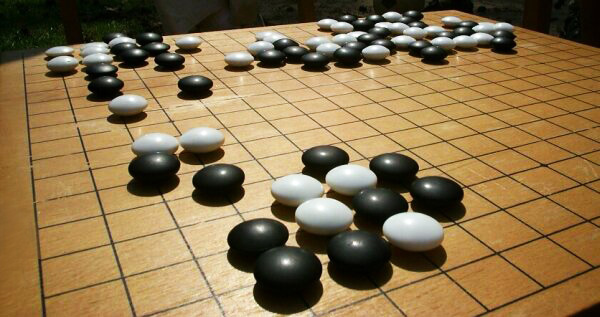
Go is a strategic board game for two players. It differs from chess by only having one type of playing piece. What it shares with chess is an infinite complexity.

For me, and many others, it all started with an animé: Hikaru no Go. The series follows a young boy through the trials and tribulations of playing Go, making it through school, trying to start a Go club and playing in tournaments. Not only was it a really well-executed animé, it also managed to make a relatively mundane board game appear epic. According to Wikipedia:
The manga is largely responsible for popularizing Go among the youth of Japan since its debut, and in other areas such as mainland China, Hong Kong, Taiwan, and South Korea. More recently it has gained much popularity in the United States.
So after watching the animé, I did a little reading and shopped around for a goban, but couldn't find any at nearly a reasonable price. The only place I could find was online, and that was too expensive. So I made my own. A nice wide plank of pine, a ruler and a carver's V-tool took me half an hour to make it. Then a little inking to make the lines sharper and a coat of varnish. I then bought two bags of glass stones, a bag clear and a bag blue. And there you have it, the poor-man's goban.

I consulted my encyclopedia of games (one of the most important books on my bookcase) and off we went. The animé also had a 5-minute lesson at the end of each episode, which helped a lot with the basics. My friends and I now play regular games. The game is quick to pick up, but it can take years to even realise the depth of the game.

If you have a chance, I would encourage anyone and everyone to watch a few episodes of the animé, or read the manga (can be read online at onemanga.com). Then you can try your hand at the game, through the Internet Go Server (a.k.a. PandaNet).


Words:
"When did this square become a meeting place for go players? I don't know. After so many thousands of games, the chequerboards engraved on the granite tables have turned into faces, thoughts, prayers."
- The Girl Who Played Go, Shan Sa


Sunday, 28 September 2008

Good Old Days

It turns out that there are still many people that enjoy a good game of pen-and-paper roleplaying.

So I went in search of my old player's manual for Vampire: The Masquerade(pictured left). Upon finding my old character sheet the memories and nostalgia came flooding back, of late nights in a small theatre with a group of drama students pretending to be vampires. The epic adventures that played out there were the stuff of legend.

But what makes the games by White Wolf so amazing (and a little scary) is the fact that these future-changing revolutions could be taking place right under our noses, for real, and we would never know...

I called up a few friends and asked around and everyone seemed keen, so we all got together one evening with the player's manual and worked out our characters. We all then spent the next week thinking about our characters and developing them from mere pieces of paper to living (I use this term lightly) breathing members of society.

If you're familiar with Dungeons & Dragons you'll know how most roleplaying games work: The chronicler (a.k.a. narrator a.k.a. dungeon master) tells the story up to a point, then stops. It's the duty of each player to state what their character would do in that situation. A few minutes of stats-comparing and sometimes arguing commences, followed by a round or two of dice-rolling (with dice that have between 4 and 20 sides). Then the story can continue based on their successes or failures. What made The Masquerade unique in its day was focus on the theatrical more than the mathematical. Your character sheet was only there as a reminder. The real character, with full background story and entire family trees and political structures, was in your head. During play, when a challenge is presented a quick calculation and a single dice-roll is all that was needed to find out what happens. The story can then continue. It made for much faster paced gameplay and much more amazing stories. And indeed, the stories were told, because when you retell the tale of your adventure you portray it as if you are the person who experienced it, not the character sheet!

Over the last week I've been combing the internet for information on The Masquerade, but it was replaced by a game called The Requiem(pictured right). No longer are the vampires an entity on their own. They are part of a much greater and sinister system known as the World of Darkness in which anything can happen, from ghosts to werewolves, in the tradition of horror stories the world over. I'm doing my best to find the books required to start playing the newer game, but not before the adventure of our Masquerade has concluded, which can take up to 3 months of weekly meetings.

With PC and console games as sophisticated as they are these days, it's good to know that we can still enjoy a good old-fashioned game of pretend, even if it is with some help...

The games also encourage you to read, so I find it especially suited for players in their low teens who are still in touch with their imagination, but who get bored when reading a book like we old people (early twenties). Once you've played a few hours with friends, you start wondering about the story behind the story. And it's all there. Beside the player's manuals and a guide for storytellers, there's a whole selection of books that widen the fictitious universe. Some of them have nothing to do with how the game is played, but are simple storybooks that serve to enrich the mental image you have of this world beneath our everyday lives.

However, it's not for everybody. The whole theme of this genre is very dark and brooding. If you struggle to keep a straight face while telling a ghost story, you would be better off playing a science fiction or fantasy game. World of Darkness is for the goths among us. Serve with Paradise Lost, My Dying Bride, Anathema and especially Katatonia.

To Close: If you've never played a pen and paper roleplaying game, there's a very big gap in your education. In my opinion it's something that everyone needs to do at least once in their life.


Words:
"The cleansing astringence of rejection" is the most ridiculous phrase I have ever used in a comic."
-Questionable Content


Monday, 22 September 2008

When a Coder Plays Games...

I enjoy PC games. At the moment I'm playing Spore and awaiting delivery of Crysis Warhead. I buy between 1 and 3 games a month depending on releases. However, my day-to-day job differs very little from the work of the game developers. How does my knowledge of the internal workings of a game affect the way I experience a game?

We plan new features, build them in stages, spend much time messing with our own creations trying to break them, and when they break we figure out how to fix them. A rally driver can most probably tell you in quite boring detail how the internal structure of a car makes it drive the way it does, but it doesn't really affect the feeling of driving.

Also, like a rally driver, simply knowing how it works doesn't make you any good at it. I'll be first in line to admit that I'm not the best at any particular type of game. Actually I pretty much suck at RTS games. A quick glance at my bookcase tells me that the closest thing to RTS I own would be SimCity 3000 (in my opinion the best of the series) and Startopia, both more disaster management than RTS. Anyway, back to the point.

When I play a game, I approach it the same way I approach everything in life:
"What is my goal? How can I achieve it? Is there a better or simpler way of accomplishing this goal? Is this cheating?"
I don't go looking for every mistake in the game I can, and tell them how to fix it. All this does is deprive me of the pleasure of playing the game. I do notice the mistakes, the little glitch that nobody else noticed or was simply too small to devote time to this close to going gold. Some critics (reviewers?) will name and shame these little glitches like it's the end of the world, but in a world where games become increasingly complex and detailed, is it really possible to cover for every possibility? I think it's wrong to even expect developers to perform such feats. If anything, the fact that I understand the work that goes into a game makes me more lenient to the mistakes or oversights in games.

I heard a very nice analogy in a podcast today, either 1UP Yours or the last GFW Radio, not sure. Allow me to paraphrase it a bit. When a programmer plays a computer game it's like pulling the curtain away from a magic show to expose all the gears and pullies and tricks underneath. But the question is, now that you understand how the trick works, does it make the trick any less impressive?

I don't think so...


Words:
"We are united by a common element. Its not the color of our skin or our ideology or where we come from. No it's that we're a giant bunch of fucking nerds."
-Ken Levine, PAX 2008 Keynote(video)


Sunday, 17 August 2008

The Price of Quality

My mom always says you shouldn't buy cheap because it'll break, and buying twenty cheap frying pans (or whatever) is more expensive than buying a single, expensive one. But how true is this?

I was watching an episode of The Gadget Show where they compared high-end speakers with incredibly expensive speakers. The end result was pretty even, even though the expensive speakers were more than 30 times the price of the reasonably priced ones. So the question is, exactly how much do you need to spend to get the quality you're looking for?

What I usually do is compare the price with the relative quality of what you're buying, so step one is to find something solid and statistical that you can compare. In the case of cars look at reliability, fuel consumption, get the opinion of other people who own the cars in question on the styling and maintenance. (Don't believe the brochures. They don't lie, but they spin the truth) For something like speakers, look at impudence, response range, volume and sound-to-noise levels. For computer parts such as 3D graphics cards, find a reputable website and get benchmarks. Next, find out what each item in your list will cost. Remember to include setup fees or maintenance plans.

Now set up a little spreadsheet or something and pull a graph. This is the trick part. You'll see that from low-end to mid-range the price will rise slowly but the quality increases dramatically. This is because manufacturers need to make the initial buy-in to produce the item. With cars you don't really have a car unless you've put wheels on it, welded the thing together, gotten it tested, etc. You will then notice at a certain point it levels out, where the price increases steadily as the quality goes up. Then suddenly you'll hit a wall where it becomes very expensive for relatively little gain. This is the cut between mid-range and high-end. When you're looking at cars (once again) the price difference between the normal model and the sport model is often quite a bit, but the performance gain isn't all that major especially if you'll only be commuting with it.

Once you've gotten this graph figured out, you'll have a mental idea of what you're paying for in each iteration. You can then make an educated decision as to what you can afford and if you're getting your money's worth.

I need to mention two things here. Firstly, people tend to decide on a budget and strictly stick to it. I think this is the wrong approach. Many times once I've made up my graph I see that I've either grossly under-budgeted (not realising what things cost) or there's an item just a little more expensive with a quite considerable improvement. Be willing to shift your budget, otherwise you end up buying inferior goods because you're stingy. If you can't afford it right now, but you can wait a month or two and save up, do so. You'll be much happier with your purchase once you make it. Secondly, consider what you're buying for. If you're buying small speakers so you can hear your computer go ding when something happens, you don't need surround sound or a subwoofer. If you're buying speakers for a home entertainment system it's a good idea to look at slightly more expensive speakers, but maybe a better idea to stick to smaller speakers that don't fill your living room.

I find that buying just below the mid-to-high-end cut-off delivers the best results, where products work well but aren't flashy or over the top. On my computer games run reasonably well and I didn't shovel out a fortune for it.

Oh, one last thing. If you're planning on buying something quite expensive like computer parts, something that's in a quickly evolving market, take a look at upcoming products. What you're planning to buy might soon be replaced by a newer model in the same price range with better features. In this case you can either buy the newer model, or you can wait for the shops to drop the price of the current model in order to get rid of it and stock the new. A win-win situation.

Having taken all this into account, I suggest you step back, take a breath, maybe have a cup of something soothing, then buy what feels right. Your subconscious often picks up on little things that you're not thinking of. One of the products might feel cheap in your hands but there's really nothing wrong with it. It's a good buy, but you'll always feel cheated.

One last thing to consider. This item that you're planning to buy... do you actually need it? Or do you just want it? But that's a topic for another day...


Words:
"If ignorance is bliss, why aren't there more happy people in the world?"
-Stephen Fry on QI (Quite Interesting)


Tuesday, 22 July 2008

Everything is Romantic.

The title will make sense in a few minutes, I promise.

We as a human race are constantly disappointed in our experiences. A new love interest is never as exciting as in your Marian Keyes book. Going to a formula 1 race is never as exciting as watching it on TV, because you miss half the action. Being a hero is never as glamorous as in the movies. Why is this?

Because media and entertainment has made us blunt. Movies and games are constantly trying to make things more real and more fantastic, and it leaves reality behind. If this relates to something we've never experienced ourselves, it shifts our expectations. A car will not spontaneously explode when hit by a train. You can't empty a pistol in someone's chest and they will still be alive, much less be able to chase you, even through kevlar.

I have two things I want to mention with regards to this, one good and one bad.

The good is shows like Mythbusters. A whole form of entertainment based on debunking the misconceptions.

The bad: People's concept of physics is fundamentally flawed. In many cases it could make truly amazing things seem boring, because in a movie you saw it to be much more impressive, even if it was fake. This is a theory called suspension of disbelief. To quote:
"According to the theory, suspension of disbelief is a quid pro quo: the audience tacitly agrees to provisionally suspend their judgement in exchange for the promise of entertainment."
This means you're willing to overlook physics because... well... "Wow! Did you see that!?"

Because of this tendency in people to believe what they see even if it's obviously faked, some lawyers are able to argue that games are harmful to children because of the violence depicted. When playing Postal, you see people rejecting you, the player, because of your deeds.

The end result is the banning of many games in countries with stricter parental control. But the effect is inverted. Because the game is now illegal, it becomes more special and interesting and people will go to greater lengths to play it.

And once they're used to the blood and carnage in this game, the next game will have to be even more gory and gut-wrenching. It's a vicious cycle.

There is no solution to this. Movies and games will always try to be better than the last. The only way the effect can be kept to a minimum is for people to realise it isn't real. We should stop expecting things to be like they are in the movies and just live life. Or better yet, be inquisitive. If you watch a movie and see someone shooting a car and the car explodes, ask yourself if this is possible.

Don't be stupid and go test it! Find out by other means. The chances are that someone has tested the theory under controlled circumstances and published the results.

A good place to start would be Mythbusters.


Words:
"The claims were that Diablo III looked more like World of Warcraft than Diablo. I don't know where these people got their impressions of World of Warcraft, because in all the Diablo III material out there, I have yet to see a bipedal cow in a wedding dress attempt to seduce a pink-haired gnome in the ancient forest of elves."
-Gameplanet Feature


Wednesday, 9 July 2008

Computers Are Suddenly Cool

Having grown up a geek, I've always been seen as a bit of an outsider. My frame of reference was slightly out of focus with the rest of my friends. The same goes for my sense of humour. You find things funny that other, seemingly normal, people don't. It's what I like to call The Geek Effect. There's even been a comedy series made on exactly how debilitating the Geek Effect can be.

People with this disorder also tend to have the same type of general knowledge: "3000 miles wide but 3 inches deep". You know enough about everything to understand it on a very high level, but you're not really intimately knowledgeable on any subject. This causes dangerous leaps in relevance during conversation. I've many times replied in what I considered to be a perfectly rational manner and was answered "How the hell did you get to that topic?".

Your work environment also tends to influence this notion, as all work environments do. If you're a geek by day (superhero by night maybe?), you spend most of your day contextually shifting between a few tasks. By extension you can do the same during conversation. For instance, you would be discussing cars, then move on to movies, and you would suddenly say: "Hey wasn't that car in this movie?"

I also have the habit of interrupting someone as soon as I know what they're going to say. Not finishing their sentence for them, but actually starting my reply. I always thought it was a character flaw all my own, until I realised my colleagues and I do it all the time. Once the notion of your talking has been passed, there's no reason to keep talking, so why do you?

But back to the topic.

Whenever I mentioned a computeristic notion in general conversation it was received with a slight sourness. "Oh you're talking about computers right? I don't know about computers." I've since developed a method of explaining geeky terms to a laman with relative ease, but that's for another post.

A few years ago I noticed things start to change. MySpace tried to make people cool, but only ended up creating a slightly less geeky geek. But when Facebook arrived it all changed. You would hear seemingly pop-culture-driven people say "I'll add you on Facebook!" It shocked me the first time a non-geek asked me if I was on Facebook.

After this initial shock, I started noticing other things. I would watch a TV show and the people in the show would be playing a game. Several movies would, soon after the movie, release a game based on the movie. These games inevitably sucked, but in my opinion it went a long way towards acclimatising people to the idea that sitting behind a computer for a few hours constitutes a respectable form of entertainment. And when they played a proper game, oh my word were they surprised! The detail! The atmosphere! The plots! It was all so much better than they thought!

Another big help in this notion was the next generation consoles. You always had your Playstation 2 players, but not until the active advertising for the xBox360and Playstation 3 was it really seen on TV or the mass media. Now it's pretty common to see that shape of the controller lying on the coffee table.

In the relative beginning of the previous century, much the same series of events transpired. The subject was also technology. It was also initially used in business and later for everyday use, and now for entertainment. It was cars. Motoracing is such a large part of our culture these days that it's hard to think at some point your average person never even considered owning a car, much less afford one within their lifetime.

In South Korea, StarCraft 2 is a national sport. They have celebreties. It's broadcast on TV with advert breaks almost longer than the match itself, warmups, discussions, magazines...

In South Africa specifically, MXit also helped. This little java-based chat application that runs on your cellphone propogated many geeky acronyms into popular culture. Things like WTF, lol and rofl are now considered commonplace. Many geeks are actually offended by this, because it was something that they could call their own. The 'secret handshake' of the masses.

This train of thought was inspired by this article from a few days ago. Read and enjoy.


Words:
"So they're demoing the game... and he's like lighting the brush on fire because there are like japanese soldiers hunkered down in camoflage, you're like burning them, they come running out and everything... Then he goes over to the hut, he like flames the hut and burns the guys out of the hut... And the flames don't catch the hut on fire even though it's a wood hut with thatch roof. I'm like 'WTF is this'.
"
-1UP Yours Podcast 27 June 2008

Tuesday, 24 June 2008

Too Safe To Care

The main reason game development companies prefer creating console games over PC, is because PC games are so easily pirated. For years companies have tried everything to keep their games safe and their players legal, from CD keys to encrypted discs to draconian rootkits.

In a few cases, these copy protection devices were so strict that legal buyers of the game were unable to play it. I myself was once unable to play a game after it detected I run a virtual DVD drive. The drive, mind you, I use when installing linux-based software to my VirtualBox, software that is usually distributed as an ISO for download.

The most memorable occurrence of this was BioShock. It was announced that the game would require players to activate their game online, and would only be allowed to install the game 5 times. Ever.

You can imagine how this upset many people. There was a public outcry on the gaming forums and the company eventually removed the activation limit last week.

The next big scandal was Assassin's Creed for PC. Some users noted funny internet traffic while playing the game, which has no multiplayer. It turns out that the game was "phoning home" every 3 minutes to make sure your copy was still legal. I have a wireless internet connection that isn't the most stable of ways to get online. On several occasions the game would completely lock up, as if waiting for something to happen, before continueing. I noticed that this didn't happen if my internet was disconnected. Proving the point that the game was indeed waiting for confirmation before continueing. This was not documented anywhere and users' permission was never asked, although upon finer reading of the license agreement it was found that by clicking "I Agree" you give them permission to collect " anonymous user data". Surprisingly this created little media stir.

But when it was announced that Mass Effect for PC would use a similar scheme (but only every 10 days or so) the general public exploded in rebellion, many urging players to pirate the game BECAUSE of the protection, thereby defeating the purpose and proving a somewhat elaborate point, which I'm getting to.

The "phone home" was removed, but in such a haste that for many people (your's truly included) the game can't even run. I'm hoping this will get fixed in the not-too-distant future, as I can't return the game.

I found out today that Alone in the Dark uses the same system. When the game is installed it must activate, either over the internet or through lengthy phone conversations with technical support. When you uninstall the game, it must revoke its activation in much the same way. This means if your computer accidentally fails under the pressure of its daily workings, there is no way to legitimately uninstall the game and it will not allow you to install again until you have revoked the activation, which means more lengthy phone conversations to explain why you want to play the game on another computer (or again on the same computer).

If I may be frank, this is bullshit. If I pay for the game, I want to play the game. Why should I need to explain myself to some third party? "Yes I legally bought the game. No it is not installed on another computer. Yes I can give you my product key."

I understand that they don't want the game to be copied, but they're trying to hard to stop people from copying it, that they convince people to pirate the game simply to avoid the shlep of activating it! You're losing precious sales here, people!

Look at Darwinia. The game has no copy protection whatsoever (as far as I can tell). It is indeed pirated and easily available on the internet, especially because it's a comparatively small download. I know a few people who illegally downloaded and played the game, but once they realized what a gem of a game it is, they went out and bought it as a sign of due diligence.

We gamers give credit where credit is due. If we think a game is worth our R315 (Alone in the Dark), we'll gladly pay it. But I might think twice about it if I know I'm going to have to explain my purchase to some woman in an office 10 000km away, if not overseas. And then the game might not even work because of my shoddy internet connection! I can see it now.

"Hey John let's play Alone in the Dark!"
"OK but I need to get my internet running..."

...followed by pointless fiddling with a foil-covered paper plate in an attempt to direct the onmidirectional signal out a window towards a tower...

Bottom line: If you try too hard to stop people from pirating your game, they're going to pirate your game just to spite you. If you let people (relatively) freely distribute your game illegally, many people will feel obligated to pay for the game and you will end up with more sales.


Words:
"But it's not. It's basically an 18 to 28 year-old male dominated business of about 15 million. That's where most of the traffic is. Casual games on the net add to that, but they're all network-based."
-CVG Article


Sunday, 8 June 2008

Is PC Gaming Dead?

Let's jump on the band wagon, shall we. Over the last few months there was a sudden uproar of console gamers saying PC gaming is dead. They cite many sources to prove this, and PC gamers counter with their own proof. It's all become a little tiresome. So when this morning I stumbled upon another of these articles, I decided it's time to give my own opinion.

PC gaming will never die. It will only change. But this is nothing new. The whole point of game development is innovation. Every game designer wants players to experience something they've never experienced before.

It's a simple cycle, really. It all started with the Sinclair ZX Spectrum and Commodore 64 in 1982. The first fully-assembled home computers available. You bought yourself one, plugged it into your TV, and off you go. They both featured a built-in programming environment that allowed technophiles to create their own applications and games. It still took a little work to get the games working.

Then in 1985 came the Nintendo Entertainment System (NES), also known as the Famicom. It was by no means the first game console, but it was the first console to have nearly as wide a fan base as computers did. What made it special was the fact that you could purchase a game cartridge, put it in, and it works. The two game controllers (pictured in their storage position on the sides of the console) meant players didn't need to share a keyboard when playing games. This simplicity of use is what made it so much more popular as a gaming console than home computers, that were originally built for office work, not games.

Since then personal computers and consoles have been running side by side, trying to pursuade the same consumers that one is better than the other, though their capabilities remained relatively similar. So similar in fact that many game publishers were able to release their games on multiple platforms.

It was only with the advent of the Sony Playstation that the "riots in the streets" started. At the time of release the Playstation's graphics capabilities far outperformed desktop computers. Games didn't need to be installed and configured before playing, and saving your game on a memory card meant you could take your game with you and play on a friend's console. It was believed that PC gaming was dead.

Within a year or two computers had again taken the market. Because of the modular design of computers, consumers were able to replace certain parts of their computer at a relatively low price and drastically improve performance and capabilities. Games could then use this new hardware to make games look, feel and sound more realistic. Because the Playstation was a single, solid, prebuilt machine there was no way to improve performance without releasing a whole new model and everyone spending the same amount of money (if not more) than they did to buy the original console, to get the newer console.

Until the Playstation 2 was released, PC games were far more impressive than console games. But suddenly the market was flooded again. Die-hard Playstation fans were rewarded with new bragging rights. Personal computers were running complex operating systems with tasks always active in the background while you're playing your game. This meant PC games never used hardware to the best of its capabilities. The popularisation of the Playstation 2, Nintendo Gamecube and Microsoft Xbox came with better performance than their PC equevalents, even though the Xbox was essentially built from PC parts. Once again, PC gaming was announced to be dead. But again, slowly creeped forth the technological developments of PCs allowing better games, better experience, and cheaper games.

Regarding cheaper games, let's take a quick side-line here. Many people argue that PC games are cheaper than console games. And this is true in a sense. Take a look at prices for Race Driver GRID (prices from Take2.co.za):
Playstation 3: R 699
Xbox 360: R 619
PC: R 348

But why is this? Because in most cases the gaem developer needs to buy into the development platform needed to run the game of a specific platform. To release a game in Xbox 360, developers need to distribute their game through Microsoft's publishing system, branded with their names and logo's. On PC, it only needs to run on an operating system already installed and present on almost all personal computers.

So what balances out the price? Hardware. An Xbox 360 retails for around R3000. A personal computer that runs the same games at the same level of detail would set you back at least R6000. That's excluding the TV you need for the Xbox and the monitor, keyboard, mouse, and perhaps gamepad you'll need for the PC. If you play alot of games and you don't mind tinkering with settings and the inside of a computer, PC games will work out cheaper in the long run. On the other hand, if you someday dig your Xbox and games out of the attic, you can plug it in and show it to your kids and all the games will still run exactly how they did back in the day. Whereas PC games tend not to work on newer technology. Or the newer computers are so fast that your old games runs much faster than it was meant to, rendering it unplayable.

Back to the story.

Over probably the last year the new generation of consoles was released. The Xbox 360, Playstation 3 and Nintendo Wii. Along with these games was pioneered the phrase "Next-gen gaming", which means essentially nothing, but promises a new level of detail and lifelikeness in games. Ironically, PC games have been doing it for years. But because it was such a gradual development, nobody noticed.

For the final time it seems, it was announced that PC gaming is dead. PC game sales looked to have plumetted and game development studios are no longer interested in releasing games on PC because it just gets pirated and they don't make any money. But they are wrong.

If you as a game developer have an idea for a game, but it's such a revolutionary idea that you don't know if it would work, you're not going to get a licence with Microsoft or Sony to develop the game on a console. You're going to sit down behind the computer that's in your study and try out the idea first. Because of this fundamental fact, the face of PC gaming is changing. A-list games can be released on consoles as often as they like. The best ones are always released on PC anyway (I'll get back to this point). But if you want a truly unique and interesting experience, that even occasionally requires you to use your brain, your only option is a PC. Plus, if you get stuck, you can always google it. It's a little harder to do that on a console...

A good example would be World of Goo, to be released soon. There's no way you can play this game on a console. And would you even want to?

Back to the point of the best being released on PC aswell. I've noticed a trend in the market:
  1. Games are released on console. It does very well and the developers decide to expand their target market by releasing the game for PC aswell. They go back into production.
  2. While they're busy working on the game, they fix the issues encountered by players of the console version. They fix the annoyances that made the game less-than-perfect.
  3. The game is released on PC, now better than ever. In many cases including material the console was either unable to handle or wasn't available at the time (such as extra DLC)
  4. Console owners complain that they don't get the cool stuff the PC version has. Developers see the opportunity to make even more money and go back to work.
  5. A few months later, the console "Special Edition" is released, containing some or all the new features and content that was added fot the PC version.
Step 5 doesn't always happen, though. I can list a few examples. Gears of War did very well on console, so was then released on PC, but with 4 extra levels that was removed from the Xbox360 version, because of the console's limiations. Those 4 levels didn't play well on the console because the machine was overloaded. Mass Effect won awards on console when it was released in November 2007. My copy of the PC version was delivered on thursday. It has a newly redesigned heads-up display, more action-focused gameplay, and many of the texture-based glitches experienced in the original game has been fixed.

The list keeps growing. Then when I'm done with my A-list games and need something to keep me busy until the next one comes out, I play a quiet game of Darwinia, released by a small games development company and almost unknown to gamers, it is one of my favourite games and remains addictive no matter how many other games I play inbetween. And guess what it cost me...

R100.


Words:
"Wanting is the root of all... needing... stuff..."
-Mad Money


Sunday, 1 June 2008

But is it cheating?

Here's an interesting question: If you find a glitch in a game that helps you win, is it cheating?

As (almost) always, I'm using Counter-Strike as an example. Even though it has been mostly replaced by Team Fortress 2, there are still die-hard fans that play it. (or got so good at it that they're no good at anything else and just call it gay so they don't have to play it and lose)

When Counter-Strike first came out, you could do all your usual things like walk, run, shoot, jump, etc. Everything you expect from a first person shooter. However when you jumped you seemed to travel forward marginally faster than when running. Avid games started misusing this fact in what became known as "bunny hopping", when a player moves faster than usual by continually jumping, like a bunny rabbit. Because it also makes you harder to shoot, many people see this as a trick used by the elite, and thus acceptable. Others see it as cheating or unsportsmanlike.

In most variations of Quake 3 Arena, you can bunny hop, but there's an added trick: Rocket jumping: A player fires a rocket straight into a nearby floor or wall and uses the shock wave to push them further, higher, or in some cases to unreachable sections of the map.

The question is: If the game allows it, is it really cheating? Or are you simply exploiting a vulnerability? Some argue that because the glitch is available to any player who cares to use it, it is legal. Others argue that it goes against the original spirit of the game.

In Dungeons and Dragons, there's nothing preventing you from studying the map before you start playing, especially if you're playing from a pre-written book of quests. But it would have a negative effect during play, because you have a rough idea of where in the dungeon you are. Is it considered cheating? Yes. Why? Because it's unsportsmanlike and just plain spoils the game for the other players. Does that stop you from reading tips and tricks for that specific quest? No.

The same argument applies to any sport or game. You're there to have fun, not just to win. If the other players complain that you're camping or bunny hopping, stop it. Can you even play the game if you're not allowed to hop around like an insane person?

How about pool? An integral part of the game is snookering, where you place your own object ball between your opponent's object balls and the cue ball, preventing a clear shot. That's not the cheating I'm referring to. I'm talking about a jump shot, where the player would force his cue between the cue ball and the table surface, effectively scooping the ball into the air and over the snookering ball. Most, if not all (I'm no expert) cue sport authorities prohibit this type of shot. Some even go as far as prohibiting massé (hitting cue ball from above, making it spin, effectively curveballing it). But I've played in many bars and pool halls where this shot is perfectly legal and even considered a talent. Is it part of the game or are you cheating?

You can win by exploiting the rules, but is the win quite as sweet? Will you laugh about it with your friends over a coupla beers afterwards? Or will they ditch you and go drink on their own?

I guess the only conclusion I can come to is that all affected parties must decide beforehand whether certain things are allowed, and adjust the rules of the game accordingly, such as prohibiting jump shots in pool. The assigned dungeon master can keep the quest a secret until the sitting. In the case of Counter-Strike the bunny hop was removed by forcing the player's model to regain his balance after jumping (has to take a few steps, then continue running), effectively removing the advantage gained by jumping without preventing the player from jumping. In the case of Quake 3 Arena, it has become part of the game. In War§ow it has become part of the game's core design.

So let's attribute it to evolution. No game developer or board game creator can think of every possible condition of gameplay, nor do they want to. If the rules were complicated enough to be fill a book large enough to be sold separately, would the game still be fun ?
(did I just insult D&D?)


Words:
"Genius lurks in everyone"
-Crash, Junkyard Megawars


Thursday, 7 December 2006

Discrimination

Has anyone else noticed the fact that "discrimination" is of the root word "crime"?

Let's begin:

In the aftermath of a recent school shooting in Germany, the regional governments of Bavaria and Lower Saxony have proposed new legislation that could punish those who make, distribute, or even play video games featuring "cruel violence on humans or human-looking characters" with a fine and up to a year in prison. The newly drafted bill is scheduled to go before the upper house of parliament next year.

I don't mind the bill. It's a good idea. Kids see far too much violence in the modern world. But this is where I disagree:

The 18-year old shooter, who according to an online report from MSNBC was an avid player of the popular first-person shooter Counter Strike, attacked the Scholl secondary school on November 20 in the western German town of Emsdetten, and wounded as many as 37 people before killing himself.

It's as if they went "Aha! He plays Counter-Strike! He must be a bad seed..."

Let's look at Counter-Strike. It's a team-based, round-based game where a group of terrorist group needs to protect hostages or plant a bomb (depending if they're playing offensive or defensive) and the counter-terrorist team has to rescue hostages or prevent the bomb from being planted or worst case scenario defuse the bomb. If any team is eradicated the other team wins by default. So, except for the fact that it's a computer game and you have real guns... It's simply paintball. The characters in the game don't die in any realistic manner, they never cry for mercy nothing. How can you blame such a lame game with graphics from the late 1990's and gameplay similar to a classic teenager pastime for a guy buying a gun and massacring in school?

The same thing used to happen with suicide and metal music in the late 1980's during the new wave of American Metal. In many cases that the government and Tipper Gore were unaware of metal actually saved lives because children (teenagers) realised that they weren't going through those things alone.

You really start to think "Where do they come up with this stuff?"

Slayer is an "openly satanic band and a detriment to society", according to a musicologist I shall not name. Slayer's lead vocalist is a devote catholic.

My point: People are very quick to judge you by what you do as recreation and stop listening when they find what they are looking for, not when they find the truth.

I fully understand that you cannot get to know a person fully, few people know themselves that well, before making up your mind about them, but try not to use your personal judgement and damaged history to decide why someone else did something.

OK, I'll stop now.