
When I say board game the first thing that popped into your head is probably Scrabble or Monopoly. Though these are both brilliant games, it's not nearly an accurate description of the phrase. Before computers, TV or even radio, board games were one of the most enjoyed indoor pastimes. Some board games have prevented all-out war between nations. Some games have remained unchanged for millennia. And still today board games are a popular pastime in the slightly-less-than-mainstream circles, global sales climbing 23.5% in 2008.
Broadly speaking you can split board games into a few categories, which I'll cover one at a time.
.jpg)
Abstract
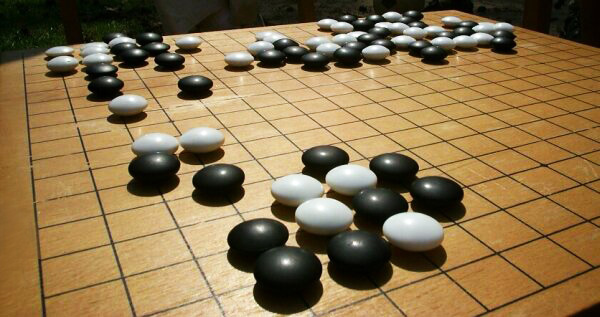
These games tend to focus on strategy more than story. Almost everyone can play Chess to some degree, but it's not nearly the only game of its kind. A personal favourite of mine is Go, a Japanese game that evokes the same strategic thinking as Chess but with far simpler rules and a certain degree of elegance that few games can achieve. Another 2-player game I enjoy is Mancala, an old African/Asian game of moving marbles or stones around little pots. For its simplicity in rules there is some amazing strategic depth.

Party Games
It happens every so often that I would be hanging out with friends and a bottle or two of wine, and someone would say "Hey let's play 30 Seconds!" This is a typical party game. Easy to learn, fun to play, with little downtime between turns. Another good example is Clue (I still have a copy called Cluedo, when it was British). Party games tend to finish in under an hour, before it becomes repetitive.

Family Games
Games that are easy to learn and easy to play, and often don't require quite as much strategy. Good examples would be Boggle, Scrabble and Upwords (pictured above). Most family games also make good party games, such as Pictionary.

Eurogames
This is where I got into board games. Eurogames derive the title from the fact that the first games of this style came from Germany and became very popular very quickly. The games tend to have a basic back story to give context and theme, but what makes them most intriguing is that each game has a unique gameplay mechanic that is found in very few other games if any. The most famous eurogame is Settlers of Catan, but Carcassonne, Ticket To Ride (links to video review) and the newcomer Dominion are all worth a mention.

Fantasy Games
These games sacrifice simplistic rules for depth of story and intense scenarios. The games tend to play longer (2-6 hours) and have a very thematic style, usually fantasy but sometimes based on a TV series or game. I wouldn't recommend these games to the beginning board gamer, but if you've played Magic: The Gathering or some form of roleplaying such as D&D you'll fit right in here. Actually, the World of Warcraft game is quite popular... My friends and I have been playing Runebound (pictured above), which is an RPG in board game form. There's also a game for Battlestar Gallactica that many people are raving about.
These games sacrifice simplistic rules for depth of story and intense scenarios. The games tend to play longer (2-6 hours) and have a very thematic style, usually fantasy but sometimes based on a TV series or game. I wouldn't recommend these games to the beginning board gamer, but if you've played Magic: The Gathering or some form of roleplaying such as D&D you'll fit right in here. Actually, the World of Warcraft game is quite popular... My friends and I have been playing Runebound (pictured above), which is an RPG in board game form. There's also a game for Battlestar Gallactica that many people are raving about.

Wargames
Warning: Only for the hardcore. These games typically take months of buying units, painting them and researching combat strategies. The rules are complex enough to emulate real-life warfare. If you enjoy RTS games you can try this, but it's not for the beginner or even intermediate player, and you'll need quite a bit of cash to get started. The most famous in this genre is Warhammer 40,000 (pictured above). There are also boardgames that give the same type of combat style without the hassle of amassing an army, though the games can still take a few hours to play. I would recommend HeroScape(very pretty) or Warriors of God.
So to conclude, I believe there's a board game out there for everyone. And once you're hooked you'll keep looking for something "the same but different", that will slowly introduce you to the wonderful world of board games. Places to go for more information would be BoardGameGeek, Board Games With Scott and The Dice Tower.
What board games do you enjoy? Comments welcome.

 Posts
Posts

